
AI has a "tell" and humans can now spot it

You’ve Seen This Before
Does this feel familiar in recent times? A website loads and something about the layout and design feels familiar before you’ve read a word of it. An essay lands in your inbox and by the second paragraph you sense a pattern you’ve seen before, not from a disclaimer, from the rhythm. The metaphor arrives with a beat too polished. The em dash shows up way too many times in some marketing copy. And then you know the tell: this is AI’s work.
I’ve spent 25 years watching technology promise to unlock human creativity. This is the first time I’ve seen research prove the opposite is happening when humans generate using AI and it explains, mathematically, why the “AI tell” exists at all.
Twenty-Five Models and Just Two Ideas
In October 2025, the findings of a study called “Artificial Hivemind” were released. The study was run by a team from the University of Washington, Carnegie Mellon, and the Allen Institute for AI. It won Best Paper at NeurIPS 2025, one of machine learning’s biggest research conferences.
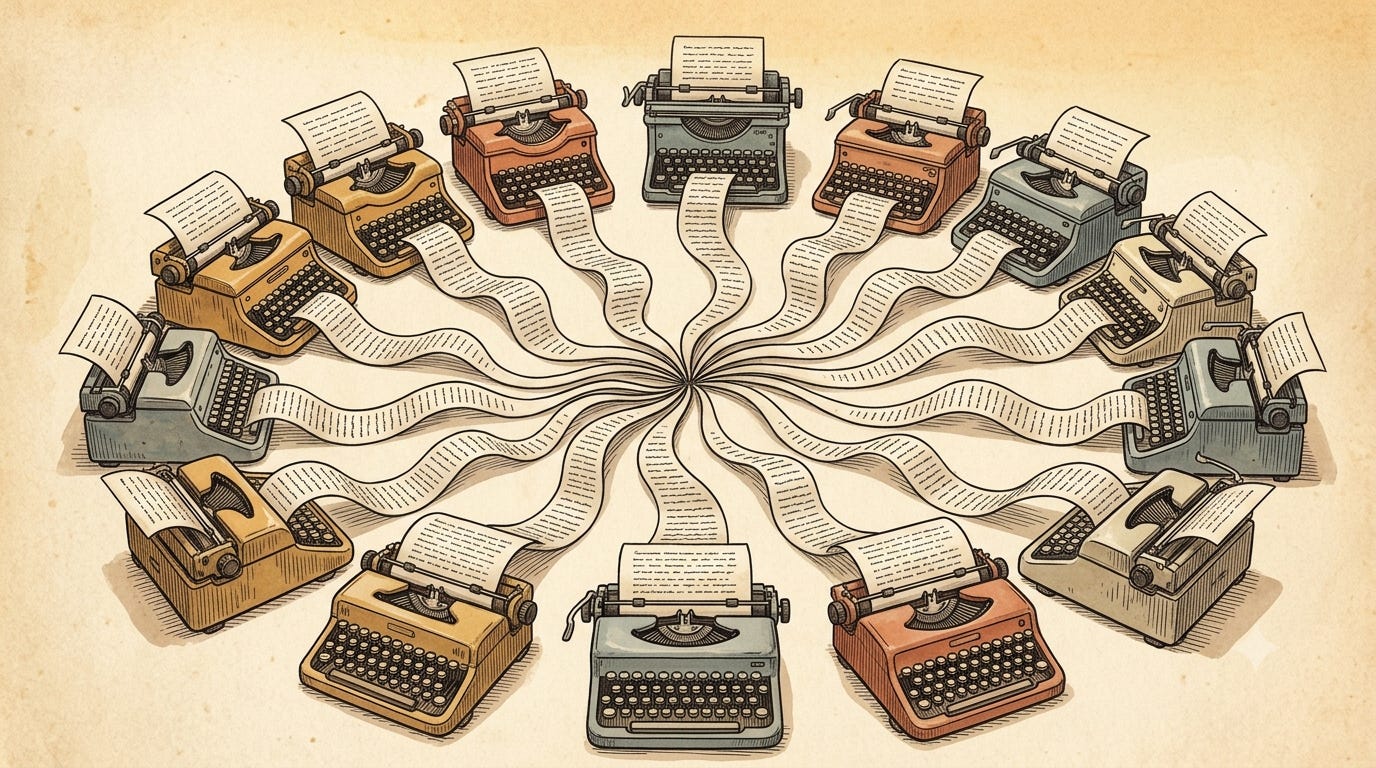
The team ran 70-plus large language models against 26,000 real, open-ended queries, the ordinary things people type into ChatGPT or Claude every day. Researchers asked twenty-five different AI models to write a metaphor about time. Fifty responses each.
The answers collapsed into two piles that were variants of “Time is a river.” and “Time is a weaver.”
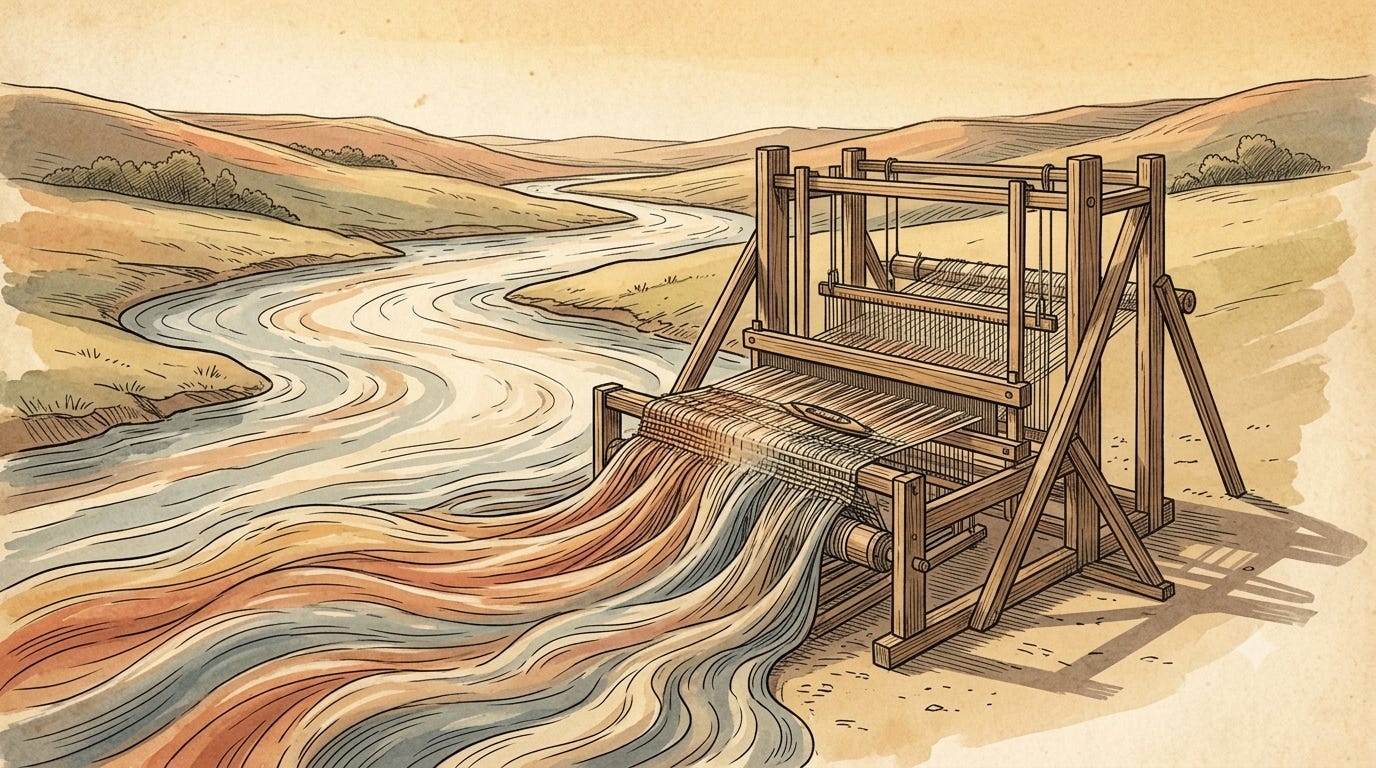
That’s it? That’s the range?
The convergence wasn’t subtle or a one-off. The same study said that, when asked to write a product description for an iPhone case, DeepSeek-V3 out of China and OpenAI’s GPT-4o out of San Francisco landed on nearly identical phrases such as: “elevate your iPhone with our,” and “sleek, without compromising.” Measured similarity between the two: 81%. DeepSeek and Alibaba’s Qwen hit 82%.
These aren’t models from the same company or country. These are competing labs, different training runs, different continents, arriving at the same sentence anyway.
This is why the AI-tell works. It isn’t that AI writing is bad, or that AI design is ugly. It’s that thousands of models are drawing from the same statistical center, the same gradient hero section, the same three-icon feature row, the same “elevate your,” the same em dash doing the same dramatic pause. You’re not spotting AI slop. You’re spotting mathematical patterns.
And a technique called distillation - training one model directly on another's outputs, the same method Washington just accused China's Moonshot AI of using on Anthropic's models - is about to tighten that convergence, not loosen it.
Better Prompting Isn’t The Answer: Proof
Today, the AI vendors’ answer to “the output feels generic” is the same: better prompts, tighter brand guidelines, more specific instructions. I believed some version of that too, for a while.
Then came a study in PNAS Nexus this March, from Emily Wenger and Yoed Kenett, running standardized creativity tasks across multiple models and comparing the spread of outputs. They tried raising the “temperature” setting, the parameter that’s supposed to inject more randomness. Higher temperature should mean more variety.
It didn’t. It produced gibberish instead and went straight from repetitive to incoherent, with no dial that landed on “genuinely varied.” Wenger said she was surprised by how total the homogeneity was.
Sit with that. You cannot prompt your way out of a model that was built, structurally, to converge toward the statistical center of everything ever written. The sameness isn’t a training oversight. It’s the architecture doing exactly what it was built to do.
Your Customers Can Tell You Use AI
Here’s the part that should worry anyone running a brand, not just anyone running a model. Klaviyo’s 2026 AI Consumer Trends Report surveyed 8,000 consumers across eight countries. Only 13% said they completely trust AI. When people notice AI-generated content in a company’s marketing, they’re four times more likely to trust that brand less, not more. 31% reported lower trust, versus 7% who said it went up.
Even inside Klaviyo’s “AI Enthusiasts” segment, people who like AI - use it daily, build it into their routines - 39% said they’d trust a brand less for using AI-generated content. These are your most forgiving customers, and more than a third of them still flinch at the AI homogeneity you push out with your brand copy.
While everyone is worried about AI replacing humans, the research says something narrower and, in a way, more useful: it’s replacing human distinctiveness, and audiences notice the difference even when they can’t name it.
The Human Moat Against AI
For most of my career, “sounding professional and polished” was the bar. Clean copy, consistent confident tone, no typos. AI cleared that bar for everyone, instantly, for free. Which means it’s no longer a bar at all. It’s table stakes.
What’s left as an actual advantage is the thing AI structurally cannot produce: an authentic point of view that existed before the model ever touched the topic. Not a branded voice document or a longer prompt. An actual opinion, held by real people, that the model can polish or pretend to have but never claim to originate.
I watch product, marketing and engineering teams treat AI adoption as the finish line: “We’re an AI-first company now.” Adoption is the starting line. Everyone crossed it at the same moment, in the same direction, saying the same thing. Two clusters. A river, or a weaver.
But What of Our AI Use and Investments?
I don’t think the answer is using AI less. I think the answer is being much more deliberate about which half of the work you hand it. Let it draft, structure, and speed up the parts that were never where your value lived anyway. But your point of view, the actual belief about your customer, your market, your product, the thing you’d argue for at a dinner table, that has to exist first, independently, before any model touches it. Otherwise you’re not using AI to express a voice. You’re using it to make you sound like billions of others.
Twenty-five models. Fifty tries each. Two metaphors for something as vast and personal as time.
So the AI tell isn’t going away. If anything, it’ll get easier to spot, not harder because the thing doing the writing was never built to have a unique self to source from.
If a machine created an artifact for you tomorrow, would anyone notice it wasn’t you? I think more and more they already do.